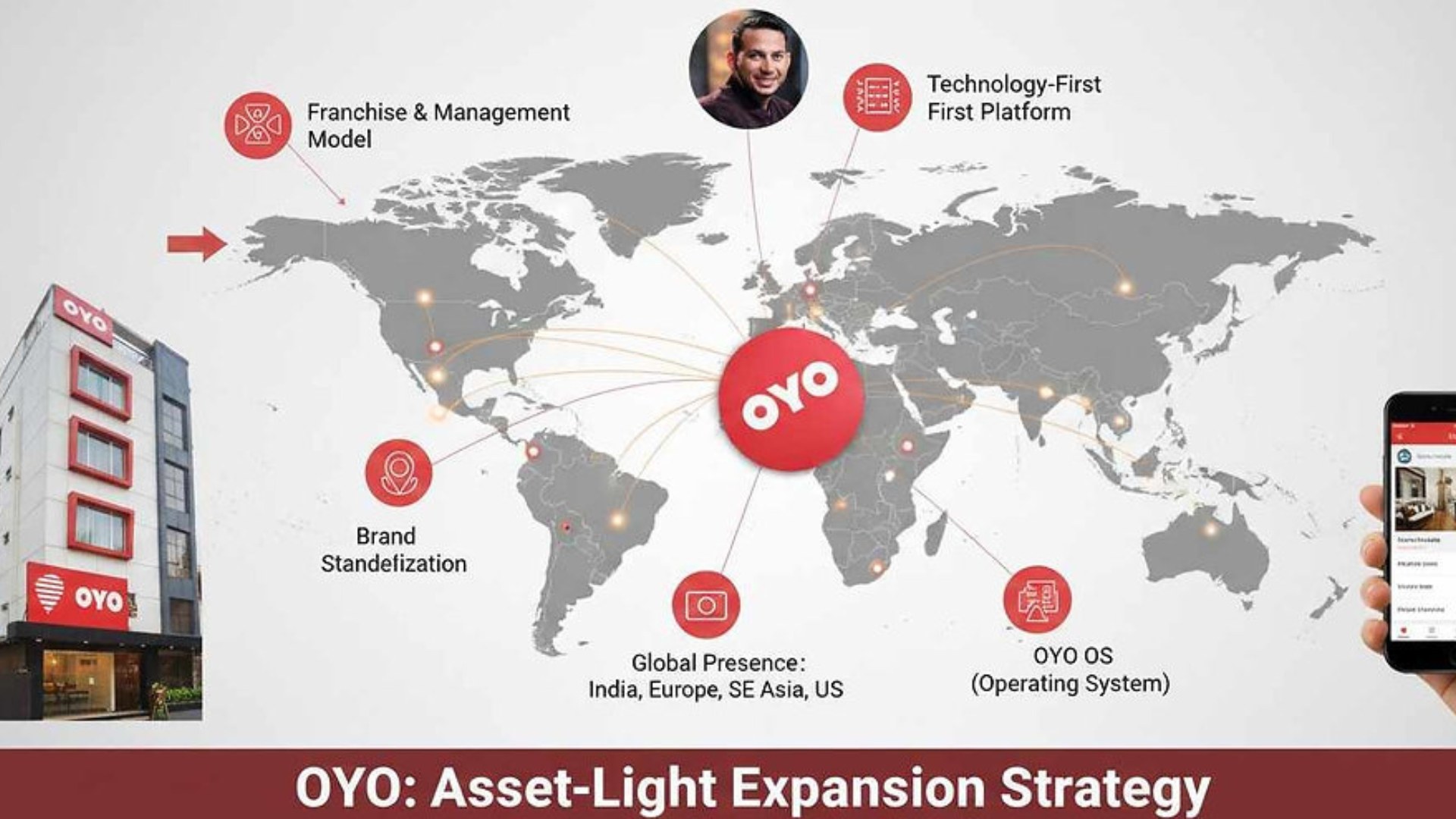
OYO began in India with an ambitious idea: bring consistency, technology and affordability to a fragmented budget hotel market. Yet the business model that helped it expand rapidly also created operational challenges. In the United States, OYO took a different route, gaining a significant foothold through established hospitality brands rather than relying solely on onboarding independent properties.

The difference helps explain why OYO’s international business has become increasingly important, although it would be inaccurate to describe the company as having simply failed in India.
India: Rapid Expansion Came With Operational Challenges
OYO’s early strategy relied on partnering with independent hotels and standardising their rooms, pricing and booking experience. The approach offered customers affordable accommodation while giving smaller hotels access to online demand.
However, scaling this model across thousands of independently operated properties proved difficult. Room quality, cleanliness, customer service and adherence to brand standards could vary considerably between locations.
The company also faced friction with hotel partners over commissions, discounting, payments and contract terms. Some property owners complained that commercial arrangements reduced their earnings or were not sufficiently transparent. Such disputes highlighted the difficulty of balancing low prices for customers with sustainable returns for hotel owners and the platform.
These problems were not unique to India, but the market’s fragmented hotel supply and intense price competition made consistent service delivery and profitable expansion particularly demanding.
OYO’s American strategy received a major boost when its parent company, Oravel Stays, completed the acquisition of G6 Hospitality in December 2024 for $525 million. G6 owns the Motel 6 and Studio 6 brands, giving OYO access to an established economy-lodging business and a large franchise network.
This acquisition changed the nature of OYO’s US expansion. Instead of building recognition one independent hotel at a time, the company gained existing brands, franchise relationships and an established operating structure.
The franchise model can also be less capital-intensive than operating or guaranteeing payments to individual hotels. Franchisees generally operate the properties and bear many property-level costs, while the franchisor earns fees and royalties under the relevant agreements.
That structure can make revenue more predictable and reduce some of the risks associated with minimum guarantees. OYO can also apply its technology, distribution and revenue-management capabilities to support the acquired business.
However, the US market is not automatically more profitable. Franchise operations still depend on hotel performance, brand standards, franchisee relationships and travel demand. Acquisitions also bring integration costs and financial obligations.
The main difference is not simply that Americans pay more for hotel rooms. Higher room rates can help, but business structure matters just as much.
In India, OYO’s historical challenge was to make a fragmented network of budget hotels deliver a consistent customer experience while keeping partners satisfied and acquisition costs under control.
In the US, the Motel 6 and Studio 6 acquisition gave OYO an established platform and franchise network. Rather than relying entirely on organic expansion, the company bought access to an existing business.
Recent financial reporting reflects this shift. OYO’s updated IPO filing, reported in 2026, identified the US as its largest revenue market for the nine months ended December 2025, contributing approximately 27.1% of revenue. India contributed about 16.2% during the same period. These figures show a change in revenue mix, not proof that OYO is unprofitable in India or that every US operation performs better.
In India, OYO’s long-term performance depends on building customer trust, improving consistency and maintaining workable economics for hotel owners. In the US, its challenge is to integrate its acquired brands effectively, support franchisees and sustain demand.
The lesson is not that OYO failed in its home market and succeeded abroad. It is that OYO’s growth increasingly depends on different business models in different markets—and its international expansion has changed the balance of its global business.






0 comments
No comments yet. Yours would be the first.