
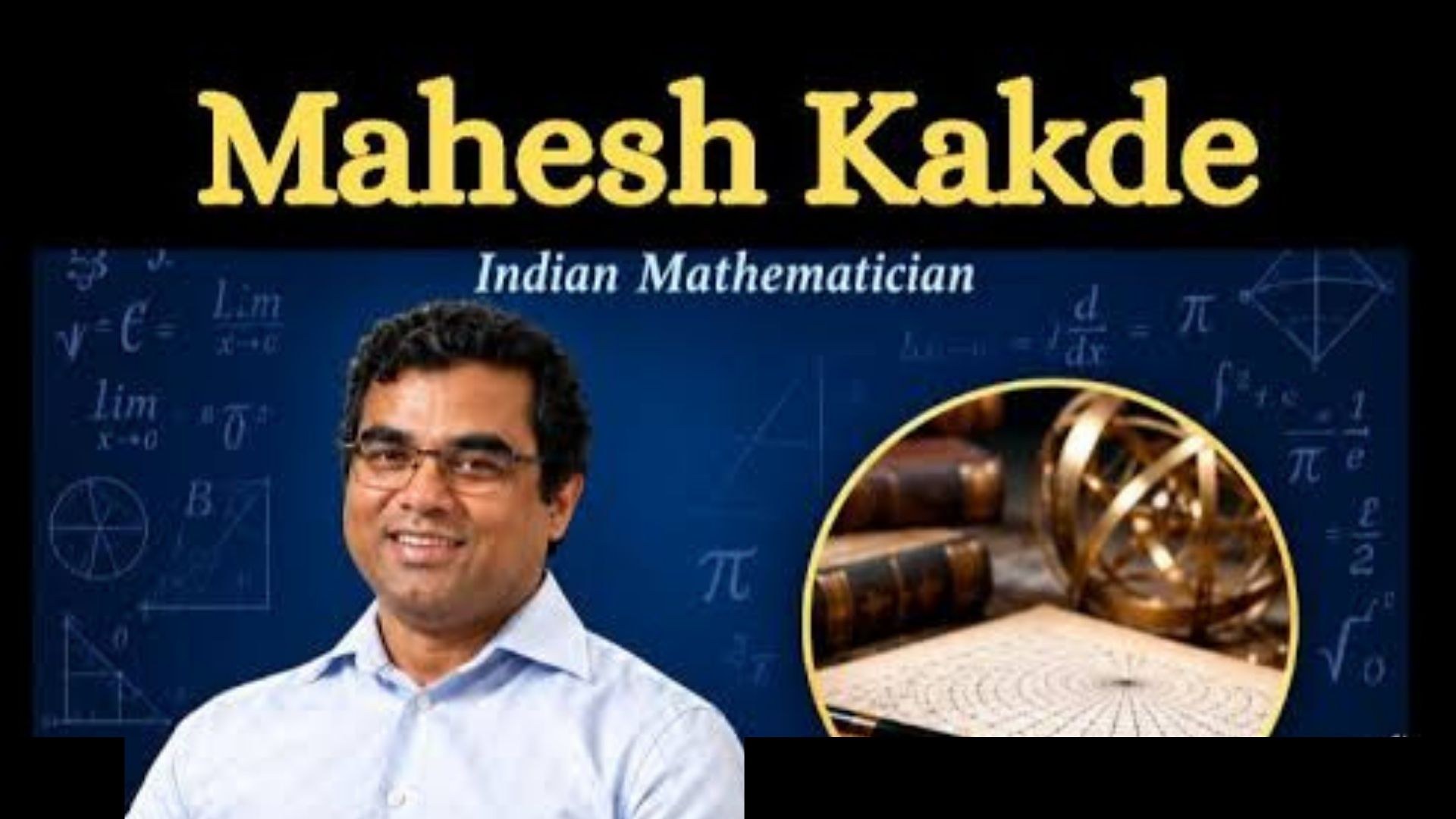
India needs to strengthen its approach to mathematics education and research, with greater emphasis on conceptual understanding rather than relying heavily on multiple-choice questions (MCQs), according to mathematician Mahesh Kakde, the winner of the 2026 Ramanujan Prize.

Kakde, a professor in the Department of Mathematics at the Indian Institute of Science (IISc), Bengaluru, received the prestigious award for his contributions to algebraic number theory. His work includes research on non-commutative Iwasawa theory and the Gross-Stark and Brumer-Stark conjectures, with connections to Hilbert’s 12th problem.
He is the fifth Indian to receive the Ramanujan Prize, recognising his contributions to advanced mathematical research.
Reflecting on mathematics education in India, Kakde highlighted how teaching and research opportunities were concentrated in a limited number of institutions after Independence. This concentration shaped the development of mathematical research and access to advanced academic opportunities across the country.
The concern over excessive dependence on MCQs points to a broader challenge in mathematics learning. While objective questions can help assess knowledge and support competitive examinations, mathematics also requires logical reasoning, proof-based thinking and the ability to solve unfamiliar problems.
Building these skills is important not only for students preparing for examinations but also for those who want to pursue research and higher studies in mathematics.
Kakde’s recognition brings renewed attention to India's mathematical research community and the importance of nurturing future researchers. Expanding access to quality teaching, strengthening academic institutions and encouraging deeper conceptual learning could help more students




0 comments
No comments yet. Yours would be the first.