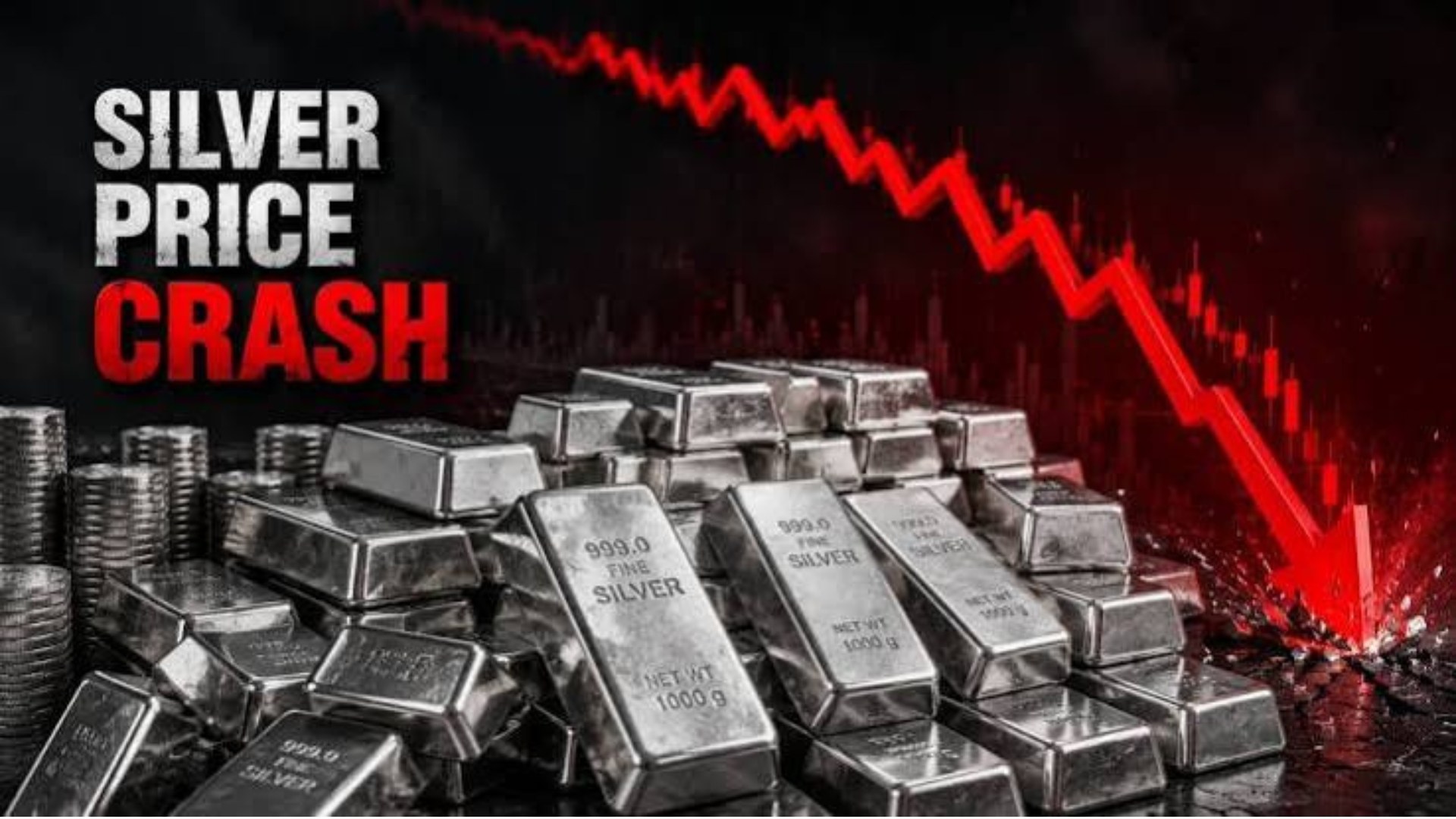
Silver prices have suffered a sharp correction after reaching record highs earlier this year, turning a spectacular rally into a painful reversal for investors who entered the market near its peak.

The precious metal touched $121.785 per ounce on January 29, 2026, before falling to $44.025 on November 19. The decline of approximately 63.84% highlights the volatility of commodity investments and the risks of buying after an asset has experienced a steep rally.
How much would a $10,000 silver investment have lost?
An investor who put $10,000 into silver at its January peak of $121.785 per ounce would have purchased approximately 82.11 ounces.
At the November 19 price of $44.025 per ounce, that holding would now be worth approximately $3,618.
Illustrative investment calculation
| Initial investment |
$10,000 |
| Purchase price | $121.785/oz |
| Silver purchased | 82.11 oz |
| Current value |
$3,618 |
| Investment loss |
$6,382 |
| Percentage loss |
63.84% |
The loss becomes substantially larger as the original investment increases. An investor who invested $50,000 at the peak would have seen the investment decline to approximately $18,082, while a $100,000 investment would have fallen to roughly $36,164.
Why recovering losses is harder than it appears
A 64% decline does not mean an investment needs to rise by 64% to recover its original value.
An investment that falls from $10,000 to approximately $3,618 must gain nearly 177% from its reduced value to return to $10,000.
For silver to return to its January peak, prices would need to rise from $44.025 to $121.785 per ounce. This illustrates the mathematical challenge of recovering from large portfolio losses.
Should investors average down?
Averaging down involves buying additional units after an asset declines, reducing the average acquisition price.
For example, an investor who initially purchased $10,000 worth of silver at $121.785 per ounce and invested another $10,000 at $44.025 would bring the average purchase price down to approximately $64.67 per ounce.
However, averaging down also increases the total amount exposed to the asset. It does not guarantee recovery and can magnify losses if prices decline further.
Why silver is falling despite supply concerns
Silver's supply-demand fundamentals have remained a point of discussion among market participants. The Silver Institute has projected a global supply deficit of 46.3 million ounces in 2026, compared with 40.3 million ounces in 2025.
However, supply deficits alone do not determine prices. Investor positioning, speculative activity, liquidity, industrial demand expectations and broader financial-market conditions can all influence short-term movements.
Silver is also historically more volatile than gold, making sharp price swings particularly significant for investors.
What should investors consider?
For Indian investors holding silver ETFs, silver mutual funds or physical silver, the correction highlights the importance of diversification and disciplined asset allocation.
Falling prices may attract investors looking to accumulate gradually, but decisions should take into account investment horizon, risk tolerance, existing exposure and the possibility of further volatility.
The broader lesson is that protecting capital during sharp market rallies can be just as important as participating in potential gains.








0 comments
No comments yet. Yours would be the first.