
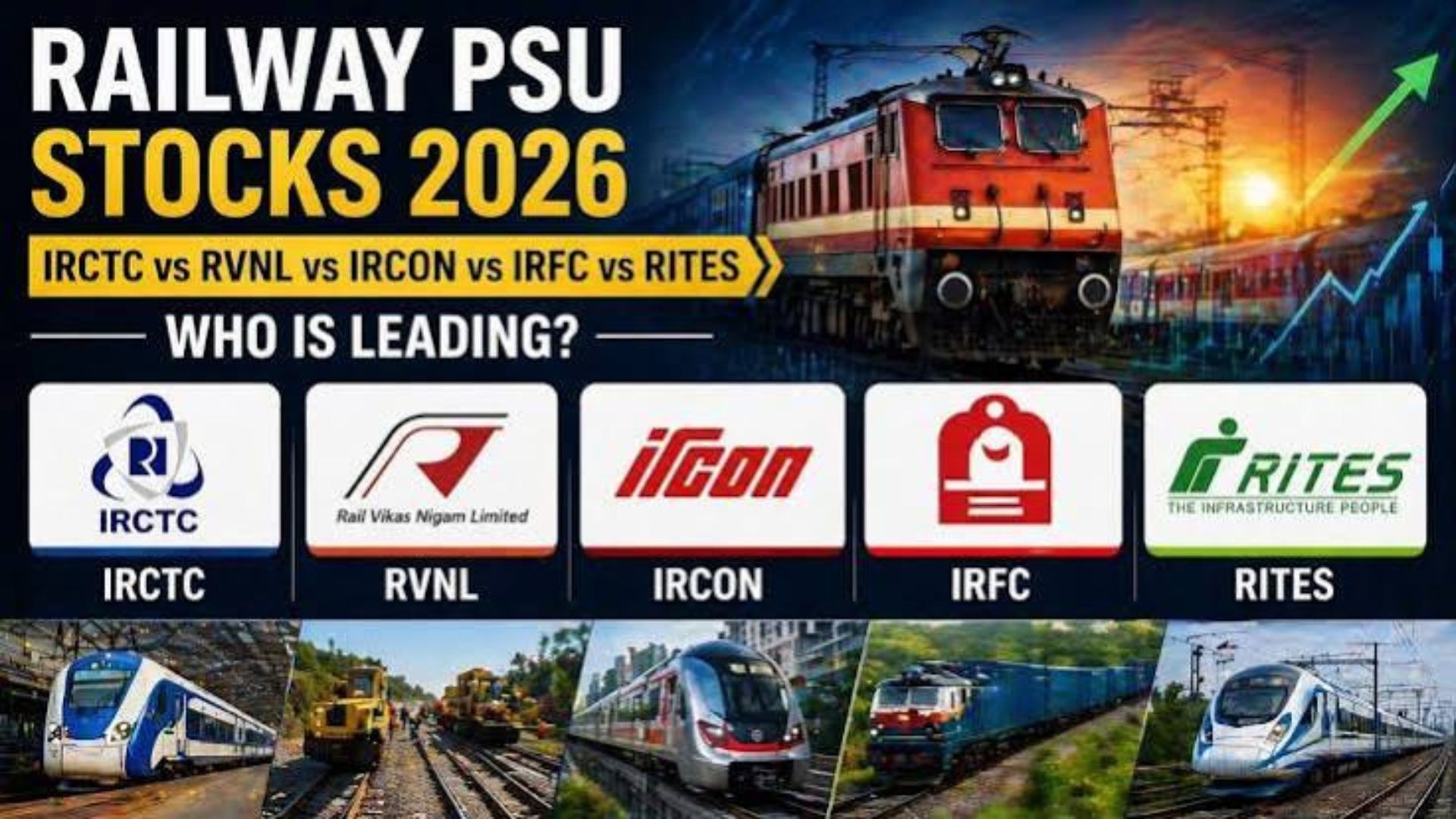
Railway public sector undertaking (PSU) stocks have faced a sharp correction over the past year, with shares of Rail Vikas Nigam Limited (RVNL), Indian Railway Finance Corporation (IRFC), IRCON International, RITES, RailTel and Indian Railway Catering and Tourism Corporation (IRCTC) coming under pressure. The decline has raised questions about what went wrong with railway stocks and whether the sector can regain investor confidence.

According to market experts cited in the October 17, 2026 report, the correction reflects a combination of expensive valuations, slower growth, pressure on profit margins and delays in converting order books into revenue. The weakness does not necessarily indicate a reduction in railway spending. India's railway capital expenditure for FY27 is budgeted at a record ₹2.93 lakh crore, but higher spending alone may not translate into stronger earnings for every company in the sector.
Tushar Badjate, Director of Badjate Stock & Shares, described the downturn as primarily a valuation correction, followed by an earnings-related adjustment. Railway PSU stocks attracted significant investor interest during the 2023–2024 rally, when expectations of sustained growth pushed valuations higher. As earnings and execution failed to match some of those expectations, investors began reassessing the prices they were willing to pay.
The scale of the correction has been substantial. According to figures cited in the report, RVNL fell 40.58% over one year and 58.34% over two years, while IRFC declined 35.58% and 46.72%, respectively. IRCON International lost 38.34% over one year, and IRCTC fell 35.10%. RailTel declined 31.49% over the same period. RITES was an exception in the one-year comparison, gaining 16.60%, although it remained down 31.22% over two years. These figures reflect the source report and should be checked against current market data before publication.
One of the main concerns is the gap between reported order books and actual execution. RVNL reportedly had an order book of ₹93,492 crore, while RITES had a record order book of ₹9,445 crore. However, the value of outstanding orders does not automatically translate into immediate revenue or profits. Badjate noted that only around ₹40,000 crore of RVNL's order book was under execution, while its EBITDA margin stood at 4.4%.
Profitability has also come under pressure at some companies. IRCTC reportedly recorded revenue growth of 18% in the latest quarter, but its profit remained flat as its margin declined to 28.2% from 34.3%. IRCON's consolidated profit fell to ₹92.7 crore from ₹164.6 crore, with joint-venture losses cited as a contributing factor. These examples highlight why investors are increasingly focusing on earnings quality and margins rather than relying solely on order-book size or government backing.
The correction has also challenged the perception that railway PSUs are protected from competitive pressures. While government infrastructure spending provides opportunities, companies executing projects still face operational risks, execution delays and margin constraints. A large order book can support long-term revenue visibility, but it does not guarantee timely delivery or higher shareholder returns. Similarly, a lower share price does not automatically mean a stock is undervalued if its earnings outlook remains weak.
Despite the recent weakness, some analysts remain constructive on the sector because of the continued railway capital expenditure cycle. Research analyst Nitant Darekar of Bonanza highlighted RVNL's large order book, expected revenue growth of around 15% and diversification into areas such as ports, hydropower and overseas projects. However, thin margins remain an important factor when assessing the company's earnings potential.
The outlook is not uniform across railway PSU stocks. Investors need to assess each company's valuation, execution record, profit margins, cash flows and ability to convert orders into earnings. The sector's long-term infrastructure opportunity may remain intact, but future share-price performance will depend on whether financial results can support market expectations.
The key lesson from the railway PSU correction is that strong government spending and a promising business outlook are not enough on their own to justify any valuation. As investors become more selective, companies that demonstrate consistent execution, sustainable margins and dependable earnings growth may be better positioned to restore confidence. The correction, however, does not establish that all railway PSU stocks have reached their bottom.




0 comments
No comments yet. Yours would be the first.