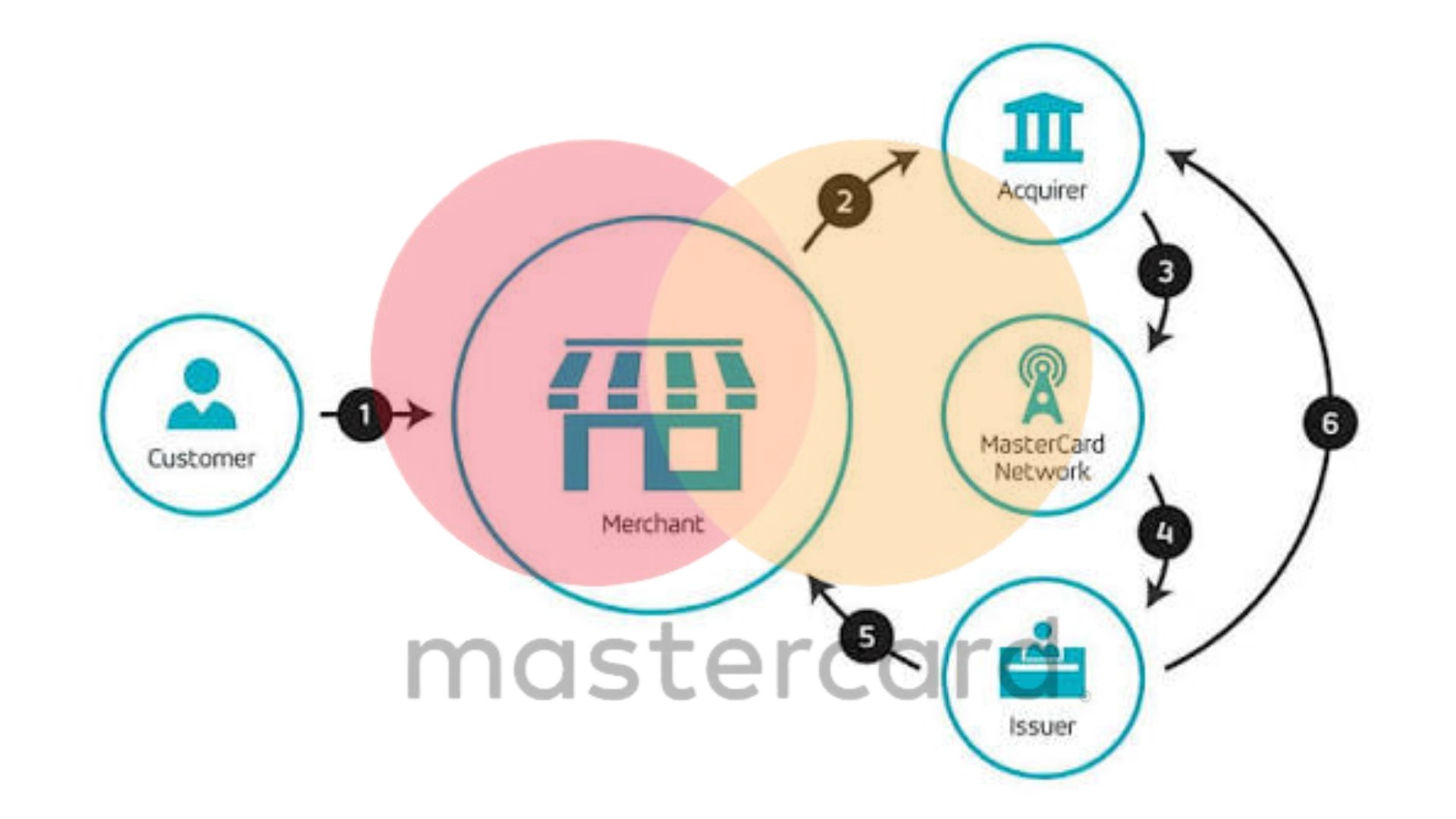
Every time someone taps a Mastercard at a checkout counter, a complex financial network works behind the scenes to authorise the payment. Mastercard does not operate like a conventional bank that primarily lends money or accepts deposits. Instead, it provides the technology and infrastructure that connects consumers, merchants and financial institutions.

Its business operates through a four-party payment model: the cardholder, the merchant, the issuing bank and the acquiring bank. When a customer makes a payment, the merchant's terminal sends transaction information to its acquiring bank. The request travels through Mastercard's network to the issuing bank, which checks the account and returns an approval or decline decision.
Authorisation is only one stage. Clearing involves exchanging transaction information between banks, while settlement facilitates the transfer of funds. These processes are distinct, meaning an approved payment does not necessarily mean the merchant has already received the money.
Security is another important part of the business. Mastercard's Decision Intelligence Pro uses artificial intelligence and network intelligence to help banks identify suspicious transactions and reduce false declines. The company said its generative AI-enhanced system can analyse one trillion data points and improve fraud detection within 50 milliseconds.
Mastercard also generates revenue through network assessments, transaction-processing fees and value-added services. Its 2025 annual report recorded $32.8 billion in net revenue, including $19.5 billion from its payment network and $13.3 billion from value-added services and solutions. It processed 175.5 billion switched transactions and reported $10.6 trillion in gross dollar volume.
Beyond cards, Mastercard is expanding into account-to-account payments, open finance and cybersecurity. Its acquisition of threat-intelligence company Recorded Future for $2.65 billion strengthened its security capabilities.
The larger strategy is clear: Mastercard wants to remain essential not just when people use cards, but wherever money moves digitally.



0 comments
No comments yet. Yours would be the first.