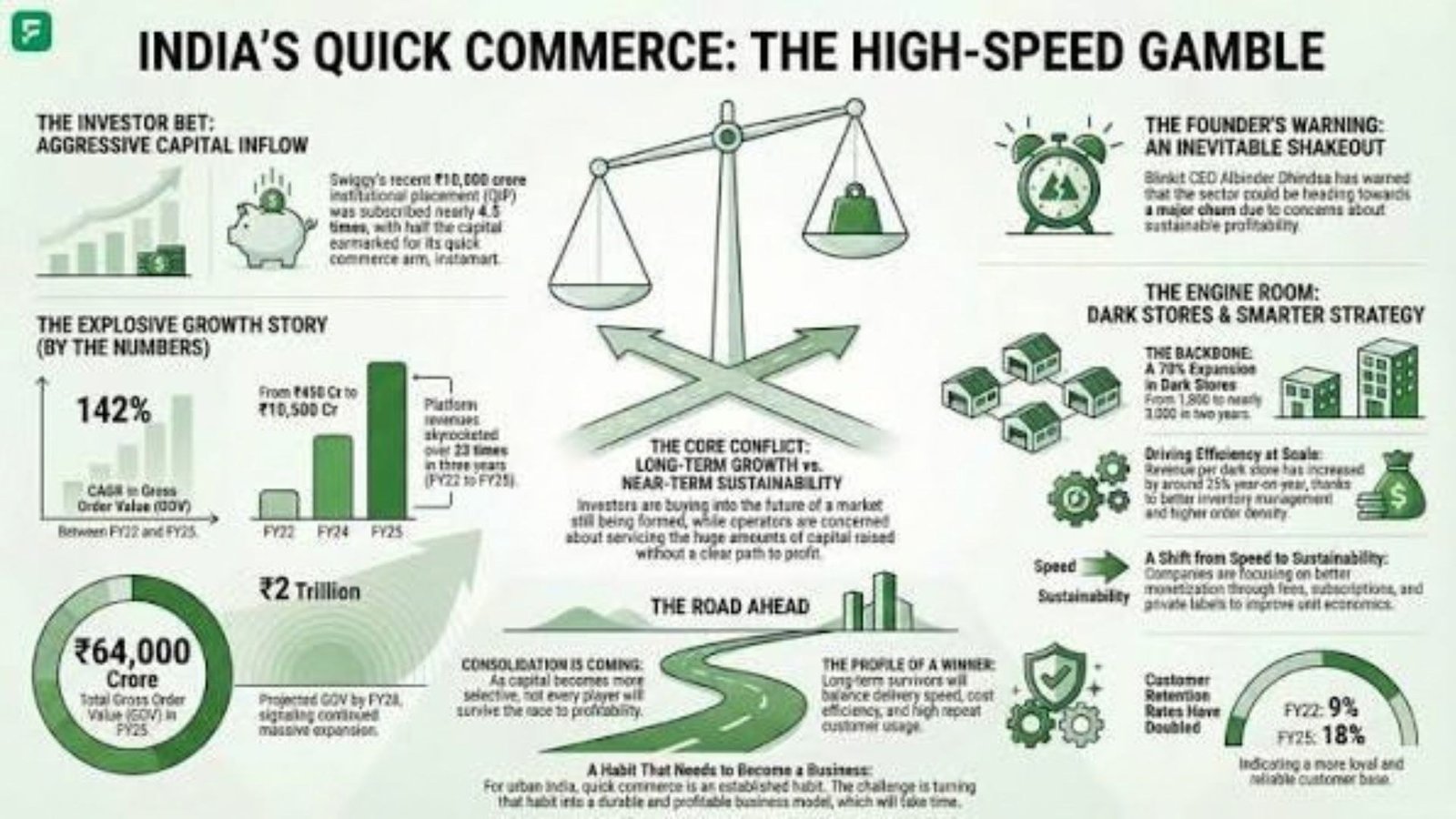
India’s quick-commerce sector is entering a new phase, with companies increasingly shifting their focus from rapid expansion and order growth to profitability and sustainable business models.

The sector was initially driven by the race to deliver groceries and essentials within minutes, expand dark-store networks and capture market share. However, rising competition is now putting greater emphasis on the economics of fulfilling each order.
As of Q1 FY27, Blinkit was the only major player mentioned to have reached positive EBITDA, with an adjusted EBITDA margin of 0.6% and EBITDA of approximately ₹3 per order.
Meanwhile, Instamart and Zepto continued to report losses on an order-level basis. Instamart’s EBITDA loss was around ₹68 per order, although its economics have improved significantly over the past year. Swiggy’s reported improvement in adjusted EBITDA per order was around ₹29, reflecting progress in its contribution economics.
Zepto’s EBITDA loss stood at approximately ₹60 per order as of Q4 FY26.
These figures highlight why order volumes, GMV and dark-store counts alone may no longer define success in quick commerce. The ability to convert scale into sustainable margins is becoming increasingly important.
With capital continuing to flow into the segment and competition intensifying, the sector appears to be moving toward a profitability-focused reset, where operational efficiency and unit economics could play a larger role in determining long-term sustainability.