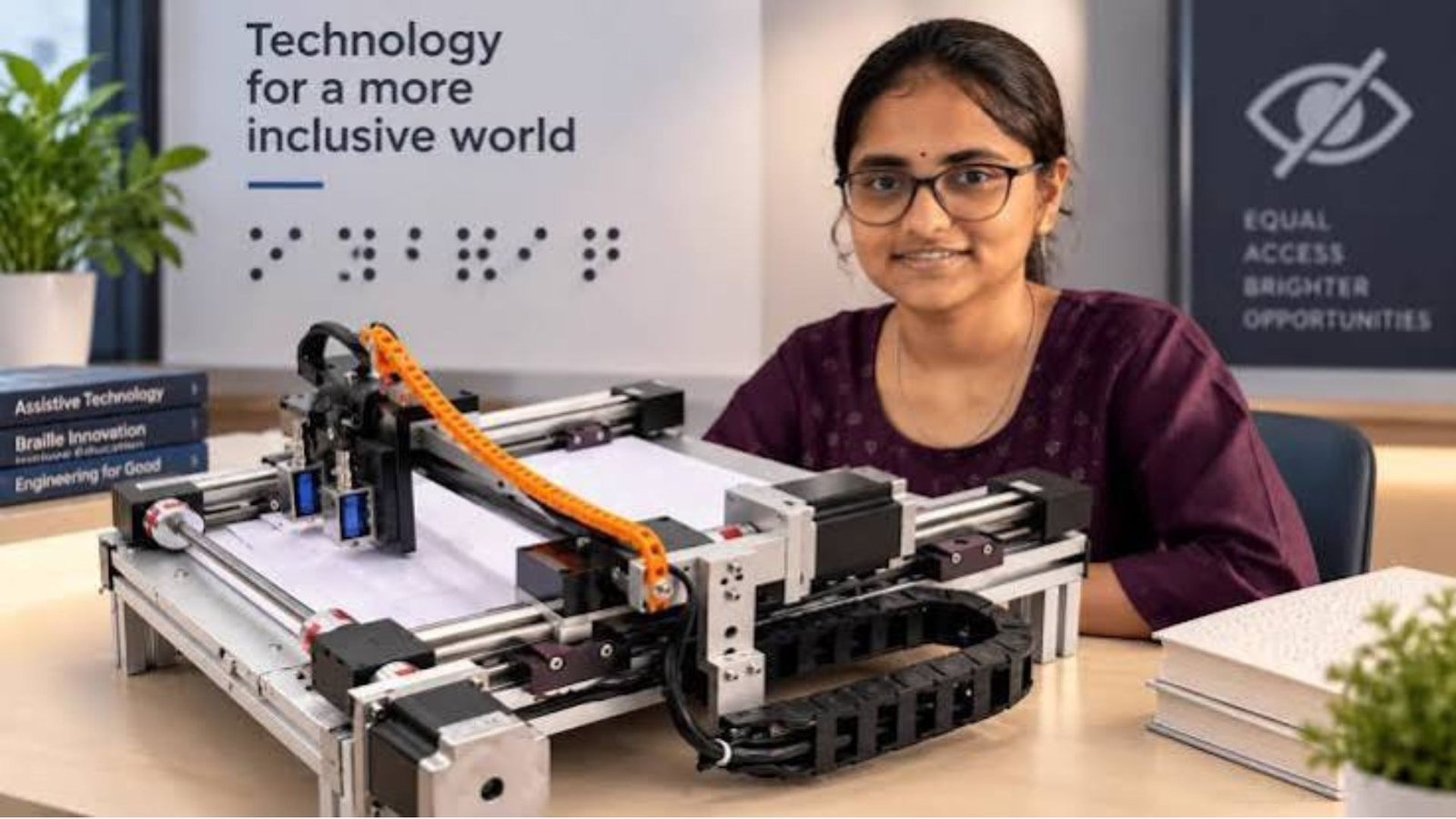
A question from a visually impaired student prompted engineering student Himaja Lingampalli to rethink how Braille could be written and experienced, eventually leading to an innovation that won her the James Dyson Award in India for 2026 and a Rs 6 lakh prize.
While visiting a school for visually impaired children near her college, Lingampalli, a fourth-year BTech student at Sri Vishnu Engineering College for Women, observed students using traditional Braille slates and pins. The process requires users to apply pressure to create raised dots and then turn the paper over to read the characters from the reverse side.
The experience led her to explore whether technology could make Braille writing easier and more intuitive.
Her project, Rudhra, is designed to convert spoken words into Braille and print the resulting pattern in a way that allows users to physically sense the characters in their intended form, rather than having to reverse the sheet and interpret the pattern.
The innovation aims to address both the physical effort involved in traditional Braille writing and the difficulty of reading the resulting text.
Lingampalli’s journey highlights how direct interaction with users can shape practical assistive technology. By focusing on an everyday challenge faced by visually impaired students, Rudhra seeks to make Braille more accessible while using technology to improve the learning experience.
Her recognition through the James Dyson Award also brings attention to student-led innovation focused on accessibility and inclusive education.